

Last Updated: November 10, 2026
Quick Summary
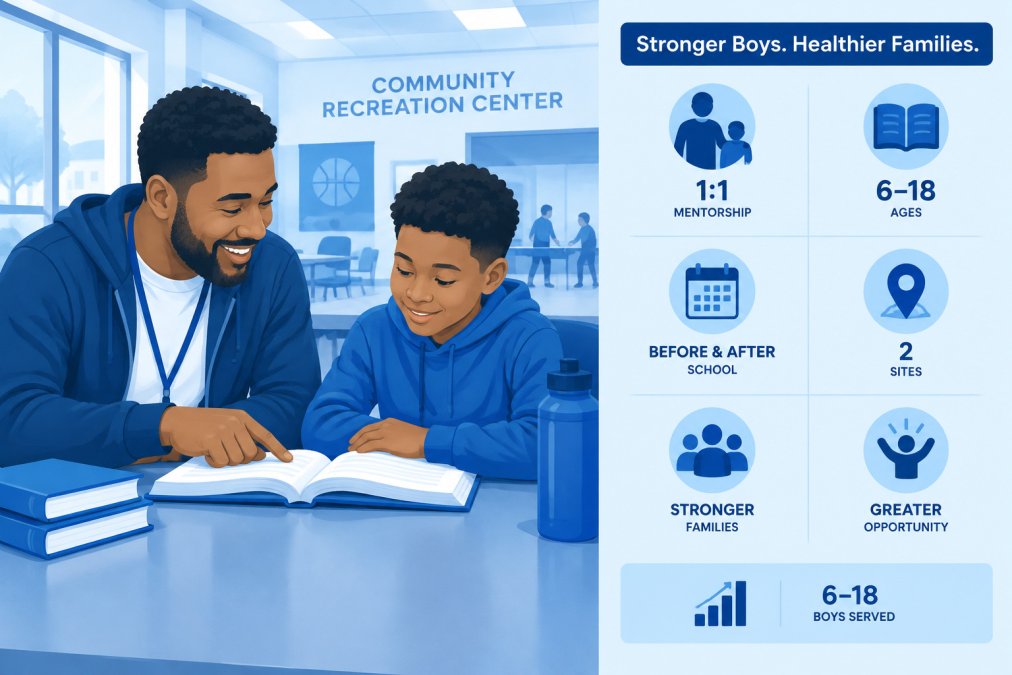
Youth mentorship programs give boys aged 6 to 18 a steady, trusted adult who offers guidance, encouragement and accountability over time. This relationship supports academic progress, emotional resilience and reduced risk, and families gain reliable, supervised after-school care.
- Research finds the most consistent benefits when mentoring matches last at least a year.
- Integrated tutoring works best when sessions are regular and predictable rather than occasional.
- Strong programs address confidence, discipline and showing up, which carry over into the classroom.
- Families should ask programs how they screen and train mentors and how they measure progress.
- Free before and after-school options can be especially valuable for working parents.
Table of Contents
Youth mentorship programs give boys aged 6 to 18 a steady, trusted adult to turn to, and that single relationship can shape how a young man approaches school, his peers and his own future. This guide explains the benefits of youth mentorship programs for boys and their families in Washington, DC, and across the wider United States, and it shows what to look for when choosing one.
The Protégé Project was founded and is guided by Clementina Maduforo, and it offers free before and after-school programming that blends academic support, mentorship and recreational sports.
Mentoring, in its simplest form, is a sustained relationship between a young person and a caring adult who offers guidance, encouragement and accountability over time. Researchers in youth development describe these relationships as a protective factor, meaning a source of support that makes it easier for young people to navigate difficult circumstances. National Mentoring Partnership research on youth mentoring
For families, the appeal is practical as well as emotional. Parents who work irregular hours need reliable, supervised care for their sons after school, and a structured program can provide that without a family having to pay for it. A common mistake is assuming that mentorship is only about grades. In practice, the strongest programs address confidence, discipline and the habit of showing up, which then carry over into the classroom.
Youth mentorship is also widely studied as a way to reduce risk. The U.S. Department of Justice and other federal agencies have funded research into youth mentoring as a violence and delinquency prevention strategy, and the findings consistently point to the quality of the relationship as the factor that matters most. U.S. Department of Justice youth mentoring research
Youth Mentorship Statistics: What the Research Shows
Research on mentoring programs has grown considerably, though results vary with program design, length of match and how well mentors are trained and supported. Evaluations generally find the most consistent benefits when matches last at least a year and when programs maintain regular contact between mentor and mentee.
Program leaders often track a few core indicators: attendance, the length of mentoring relationships, changes in school engagement, and participants’ self-reported confidence. Looking at these alongside grades gives a fuller picture than academic results alone.
Because outcomes depend heavily on implementation, families should ask any program for its own evaluation data rather than relying on general claims about mentoring.
The Impact of Mentoring on Youth Academic Success
Academic gains are among the most frequently reported benefits of mentorship, and they tend to appear through consistent homework support, improved school attendance and a more positive attitude toward learning. A mentor who checks in on schoolwork each week can catch problems early, before a student falls behind.
Tutoring integrated into a mentorship program works best when it is regular rather than occasional. Short, predictable sessions help boys build study habits they can keep using without a program in place.
Why Is Mentorship Important for Students?
Mentorship matters for students because it gives them a relationship that school alone may not provide. A trusted adult outside the classroom can help a student set goals, talk through setbacks and see a path beyond the current year.
For boys in particular, access to positive male role models can be scarce in some neighborhoods, and mentorship fills that gap in a visible, everyday way. The relationship itself, not any single lesson, is usually what makes the difference. That steady presence can also help boys build confidence and self-control through physical activity, as reflected in the approach of Man of War Boxing & Fitness.
Social, Emotional, and Behavioral Benefits for Boys
Beyond academics, mentorship supports the social and emotional skills that shape how a young person handles conflict, makes decisions and relates to peers. Structured group activities, such as team sports, add opportunities to practice cooperation and respect.
Building Self-Confidence and Emotional Resilience
Confidence grows when a young person is given responsibility and sees that his efforts are noticed. Mentors help boys name their feelings, recover from disappointment and try again, which is the core of emotional resilience.
Mentorship for Neurodivergent Youth
Boys who are neurodivergent, including those with ADHD or autism, can face particular challenges in traditional group settings. Families of neurodivergent boys should ask programs how they adapt group size, routines and communication styles, and whether mentors have received training to support different learning and sensory needs.
How Families Can Find Youth Mentorship Programs Near Them
Start by listing what your son needs most: academic help, structured recreation, a consistent adult relationship or a mix of these. Then check the program’s location, schedule and whether it fits around your work hours. Free before and after-school options can be especially valuable for working parents.
Ask each program how it screens and trains mentors, how often mentors and mentees meet, and how it measures progress. The Protégé Project, for example, serves boys ages 6 to 18 in Washington, DC, and coordinates programming with North Michigan Park Recreation Center and Edgewood Community Center. Families in Maryland and Virginia can also look for programs near their home, since the right fit depends on distance and daily routine.
Measuring Program Success: Key Indicators to Track
Families and community partners can measure a mentorship program’s success with a small set of indicators: attendance rates, the length of each mentoring match, changes in school grades and attendance, and the mentee’s own reports of confidence and belonging. Tracking these over several months shows whether a program is working for a particular boy.
Digital and virtual mentorship options are becoming more common and may suit families who face transportation barriers, although in-person relationships are generally considered the strongest.
Enroll Your Son in The Protégé Project Today
Many boys in Washington, DC need a steady, caring adult in their corner, and the challenge is making sure they get one at the right time. The Protégé Project offers free before and after-school programming that combines mentorship, academic support and sports for boys ages 6 to 18, with enrollment and program details available on its website. If you are ready to help your son build confidence, leadership and discipline, contact The Protégé Project to learn about its current openings, and consider supporting its work through a donation.
Frequently Asked Questions
What are the benefits of youth mentoring programs?
Youth mentoring programs give boys a consistent adult who listens, sets expectations, and models responsibility. Common benefits include stronger academic habits through tutoring, greater self-confidence, improved discipline, and more positive peer and family relationships. Programs that combine mentorship with structured activities such as sports tend to keep participants engaged for longer periods, which strengthens the relationships that produce these results. Families should look for measurable goals and regular check-ins rather than general promises.
What is the main benefit of mentoring programs?
The main benefit is a reliable relationship with a trusted adult who takes an interest in a young person’s growth. That relationship supports school attendance, academic effort, and emotional resilience, especially for boys who lack consistent positive male role models at home or in their neighborhoods. The effect depends on consistency, so programs that meet regularly and keep the same mentors over time generally deliver stronger outcomes than one-time events.
How does mentorship help students?
Mentorship helps students by pairing academic support with encouragement. A mentor can help with homework, set study routines, and talk through challenges such as a difficult class or a conflict with a peer. Students also gain goal-setting skills and a sense of future orientation, which often translates into better engagement at school. Parents can ask a program how mentors are matched with students and how academic progress is tracked.
How can families choose a youth mentorship program?
Start by asking how mentors are screened, trained, and supervised, and whether background checks are completed before any contact with children. Ask about group size and how much one-on-one time a child receives. Confirm the schedule, including whether the program runs during school breaks, and whether it accepts participants from nearby areas. Request specific information on how the program measures participant progress, and check that the program’s activities match your child’s age and interests.
What is the 5 C’s of mentorship?
The 5 C’s are commonly used in youth development to describe positive outcomes: competence, confidence, connection, character, and caring. Mentorship programs that address all five tend to help young people build practical skills, a strong sense of self-worth, healthy relationships, sound values, and concern for others. Families can use the framework to ask a program how each area is supported in day-to-day activities.
