
Last Updated: November 15, 2026
Quick Summary
Sports build youth discipline by supplying clear expectations, immediate feedback, and a reason to care, so boys ages 6 to 18 practice showing up on time, listening to a coach, and repeating drills until habits stick. Discipline grows differently by age: rules and routines at 6 to 9, goal-setting and accountability at 10 to 14, and self-direction and commitment at 15 to 18.
- Discipline is measurable through observable behaviors like arriving on time and finishing chores without reminders.
- Younger children roughly 6 to 9 build discipline through one instruction at a time and praise for effort.
- Preteens roughly 10 to 14 need to set a goal and track their own progress.
- Adolescents roughly 15 to 18 build self-direction by holding a commitment when motivation fades.
- Keep a consistent weekly routine, praise effort, and build in rest and an off-season.
Table of Contents
- Why Sports Are a Discipline Laboratory for Kids
- The Benefits of Youth Sports in Child Development
- Psychological Benefits of Youth Sports: Confidence, Resilience, and Emotional Control
- What the Benefits of Youth Sports Statistics Actually Show
- How Discipline Grows Differently at Ages 6, 12, and 18
- The Negative Effects of Sports on Child Development
- What Parents and Coaches Can Do to Reinforce Discipline
- Finding a Free, Structured Program for Your Son
- Frequently Asked Questions
Why Sports Are a Discipline Laboratory for Kids
The benefits of sports for youth discipline start with a simple fact: a practice schedule does not negotiate. Boys ages 6 to 18 can learn that showing up on time, listening to a coach, and repeating a drill until it sticks produces something they can feel. Discipline is the habit of doing the right thing when nobody is watching, and sports hand kids a low-stakes place to build it.
A field or a gym is a laboratory because the feedback is immediate. Miss practice, and your legs tell you. Ignore the coach, and the play breaks down. The consequences are real but small, which is exactly what a young person needs.
Discipline You Can Actually Measure
Most conversations about discipline stay vague. We prefer to make it concrete. You can track whether a boy arrives on time, completes homework before practice, finishes his chores without reminders, and keeps his commitment to a team for a full season. Those are observable behaviors, not personality traits.
That distinction matters. When you measure actions instead of labeling a child “disciplined” or “lazy,” you give him something he can control. Struggling with the same routine at home? the long-term value of youth accountability and structure explains why consistency and clear expectations change behavior over time.
The Benefits of Youth Sports in Child Development
Ask what sports do for a child and the honest answer is: a lot, in several directions at once. The benefits of youth sports in child development run through the body, the mind, and the social world, and they reinforce each other.
On the physical side, regular activity supports cardiovascular health, muscle and bone strength, mobility, and motor skills. It helps kids maintain a healthy weight and builds the fitness habits that carry into adulthood. The discipline connection is direct: a young athlete who learns to warm up properly, hydrate on schedule, and go to bed at a consistent time is practicing self-management, not just fitness.
The academic piece is where discipline becomes measurable. Sports participation is linked with better school engagement, time management, and cooperation, largely because a young athlete has to balance practice, homework, and sleep. A boy who struggles to start homework independently may start it without reminders once practice is on the line, because the consequence, missing practice or showing up unprepared, is immediate and social.
Socially, teamwork and communication skills develop because a team cannot function without them. A player who does not listen in the huddle gets left out of the play; a player who does not communicate on defense gives up an easy basket. Those are small, repeatable lessons in accountability that generalize to the classroom and the household.
- Physical fitness, cardiovascular health, and motor skills, plus the routine habits that protect them
- Time management and school engagement, driven by the practice-homework-sleep triangle
- Teamwork, cooperation, and communication, learned through immediate social feedback
- A sense of belonging and friendship that makes the discipline worth sustaining
What separates this from a generic benefits list is the mechanism. Sports do not build discipline by magic; they build it because the environment supplies clear expectations, immediate feedback, and a reason to care. Remove any of those three and the developmental benefit shrinks.
Psychological Benefits of Youth Sports: Confidence, Resilience, and Emotional Control
The psychological benefits of youth sports show up fastest in how a boy handles a bad day. Confidence grows from competence: he practices a skill, improves, and starts to trust his own effort. Resilience grows from losing a game and coming back to the next practice anyway. Emotional regulation is the quieter benefit.
What most articles skip is the mechanism, and the mechanism is where discipline lives. Confidence is not a pep talk; it is the accumulated evidence of having done hard things on a schedule.
Emotional control is the benefit parents notice last and value most. A young athlete learns to reset after a bad call because the game will not pause for his frustration. That reset is a skill, and like any skill it improves with repetition.
Age changes the picture, and this is where generic advice fails. Younger children (roughly 6 to 9) build confidence from effort praise and predictable routines; their emotional control develops through simple, named feelings and adult co-regulation.
A word on evidence. Research summarized by the American Academy of Pediatrics on sports and youth mental health points to organized sports as a setting where kids build stress management and self-esteem. Most of that research is observational, so it shows association more than proof of cause. That does not weaken the case; it sharpens it.
Watch out: when a boy’s confidence becomes tied entirely to performance, starting spot, scoring, winning, the same sport that built self-esteem can start eroding it. Signs to watch for include dread before practice, secrecy about results, and a drop in effort at school.
For parents who want to go deeper on building confidence in boys, a parent’s guide to youth leadership training for teenagers covers the practical side.
What the Benefits of Youth Sports Statistics Actually Show
Here is where we push back on the usual framing. The benefits of youth sports statistics are widely quoted, and many come from observational studies, which means they show correlation more than proof of cause. Kids who play sports may also have families with more time, money, and transportation.
That does not weaken the case. It sharpens it. The CDC’s physical activity guidance for children and adolescents is clear that regular activity supports health, and the discipline piece is something you can verify yourself by watching a season unfold. Treat the numbers as supporting evidence, not a guarantee.
How Discipline Grows Differently at Ages 6, 12, and 18
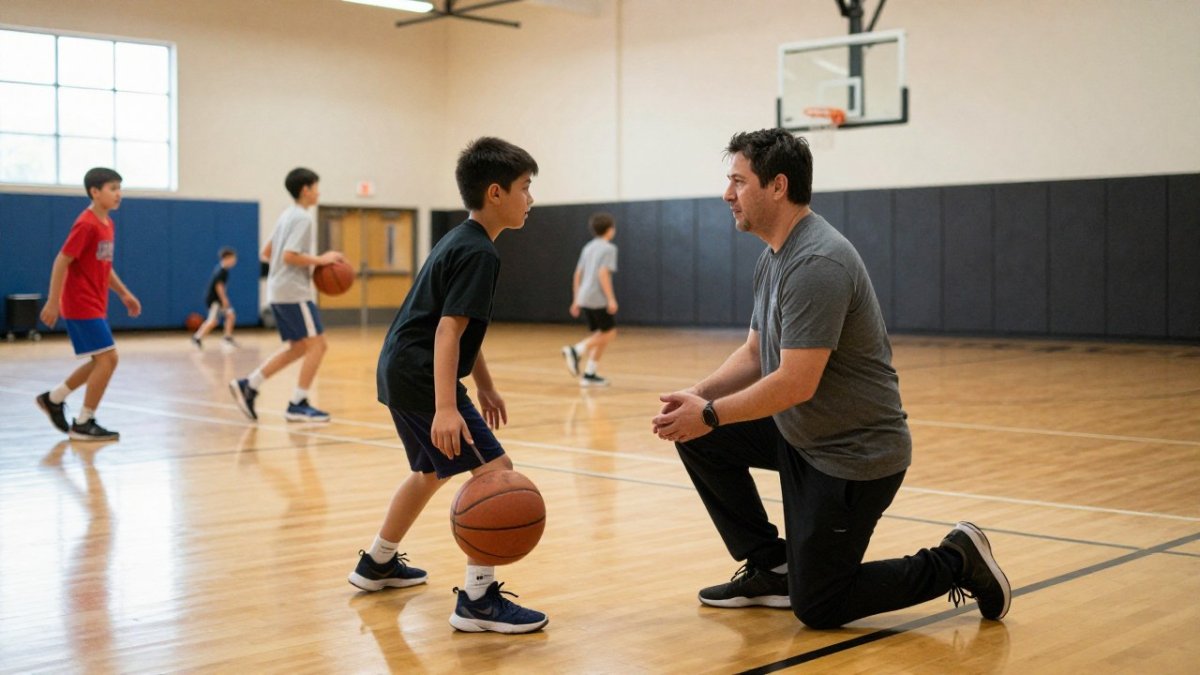
A six-year-old and a sixteen-year-old need completely different things from a coach. Treating discipline as one skill taught the same way at every age is the most common mistake we see.
Ages 6 to 9: Rules, Routines, and Following Instructions
At this age, discipline is about following rules and repeating routines. Keep it simple: one instruction at a time, a predictable schedule, and praise for effort rather than outcome. Coachability starts here.
Ages 10 to 14: Goal-Setting and Accountability
Tweens can set a goal and own it. This is the window for goal-setting and accountability, where a boy tracks his own progress and answers for his choices. How goal-setting helps young people take charge of their growth walks through the process step by step.
Ages 15 to 18: Self-Direction and Commitment
Older teens need self-direction. Discipline at this stage means choosing to commit, to a season, a role, a training plan, and holding that commitment when motivation fades. That is the version of youth discipline that lasts.
Discipline looks different at each stage, so here is how the article breaks it down by age.
| Age range | What discipline looks like | What adults should do |
|---|---|---|
| Ages 6 to 9 | Following rules and repeating routines | One instruction at a time, predictable schedule, praise effort |
| Ages 10 to 14 | Goal-setting and accountability | Let tweens set a goal and track their own progress |
| Ages 15 to 18 | Self-direction and commitment | Support commitment to a season, role, or training plan |
The Negative Effects of Sports on Child Development
Sports are not automatically good. The negative effects of sports on child development are real, and naming them is how you protect your son from them.
Burnout tops the list. Year-round single-sport training with no off-season wears kids down. Overuse injuries rise when young bodies repeat the same motion without rest. And a win-at-all-costs culture can turn a healthy challenge into anxiety, especially when a child feels his worth depends on performance.
Watch out: pushing a struggling kid to “tough it out” in a program that has stopped being fun is the fastest route to quitting sports entirely. Limits and rest are part of discipline, not a failure of it.
What Parents and Coaches Can Do to Reinforce Discipline
Adults set the conditions. A few practical moves make discipline stick:
- Keep a consistent weekly routine so practice is non-negotiable
- Praise effort and process, not just results
- Let the coach coach; keep sideline instructions to encouragement
- Build in rest and an off-season
- Ask “what did you learn today?” after every practice
The Aspen Institute’s Project Play research on youth sports makes the case that positive adult relationships are the strongest predictor of a good sports experience. The same idea sits at the heart of the role of discipline and routine in youth development.
Finding a Free, Structured Program for Your Son
Cost and structure are the two barriers that keep boys out of sports, and both are solvable. A free, structured program gives a young person the routine, the coach, and the team he needs without adding a bill to the family budget.
This is exactly where The Protégé Project fits. The Protégé Project offers free before and after school programming for boys ages 6 to 18, blending mentorship, academic support, and recreational sports. It coordinates programming on behalf of North Michigan Park Recreation Center, and it has been founded and guided by Clementina Maduforo since 2019.
If you are ready to act, our guide to free after-school sports for boys shows how to find and enroll in a program near you.
The challenge is simple: discipline does not come from a lecture, it comes from a season of showing up. The Protégé Project provides free before and after school programming that combines mentorship, academic support, and recreational sports, with positive role models and a structured environment where boys ages 6 to 18 can build leadership and confidence. Get started with The Protégé Project and give your son a place where commitment becomes a habit.
Frequently Asked Questions
How do sports help develop discipline in youth?
Sports build youth discipline through repetition and accountability. A player who shows up to practice three times a week, follows a coach’s instructions, and tracks progress toward a goal learns that effort produces results. The structure matters: clear rules, consistent schedules, and immediate feedback from a coach teach kids to manage time, control frustration, and finish what they start. Those habits transfer to homework, chores, and eventually work.
What are the possible negative effects of youth sports?
The negative effects of sports on child development include burnout from year-round play, overuse injuries, anxiety tied to performance pressure, and lost confidence when a child is benched or cut. Programs that emphasize winning over development tend to produce these outcomes. The fix is balance: limit a single sport to one season, keep practice hours reasonable, and choose programs where coaches praise effort and improvement rather than only results.
How can coaches teach discipline without being overly strict?
The most effective coaches set a few non-negotiable rules, such as being on time and supporting teammates, and explain the reason behind each one. They correct behavior privately instead of shouting in front of the group. They also give players small leadership roles, like leading warm-ups, which builds responsibility. Discipline that comes with respect tends to stick; discipline that comes from fear usually fades once the coach is gone.
How much physical activity should children and teens get?
Organized sports can cover much of the daily activity children and teens need, but free play counts too. Check current federal physical activity guidance for specific targets.
